NUWAY-K&H AGRONOMY ACCOUNT MANAGERS, DAN KNIPS, DERREK RUSSENBERGER, MATT BEZDICEK, MORGAN RINGNELL, & NATHAN VRIEZE
The 2025 season delivered impressive yields across much of our trade area, but it wasn’t just good luck. While weather played a role, the high performance came down to solid agronomic planning, timely decisions, and adapting to what each field and season required.
We believe success starts long before seed hits the soil. Our team worked closely with growers throughout the year to tailor crop plans by hybrid, placement, nitrogen needs, and management intensity and it paid off.
KEY FACTORS THAT LED TO 2025 YIELD SUCCESS
Strategic Placement & Trait Selection
Our team helped customers match hybrids and varieties to the right fields and environments. Genetics that performed best were placed where they could thrive, whether that meant tolerating higher plant populations, flexing population rates, or meeting specific nitrogen needs.
Favorable Planting and Emergence
A timely and uniform planting window led to strong emergence across the board. That early uniformity was critical in establishing yield potential early on.
Weather That Worked in Our Favor
We saw a growing season with fairly even rainfall distribution and minimal extremes. This created ideal root development, supported nutrient uptake, and enabled strong early growth. Good nitrogen mineralization helped push yields even further.
Timely Fungicide Applications
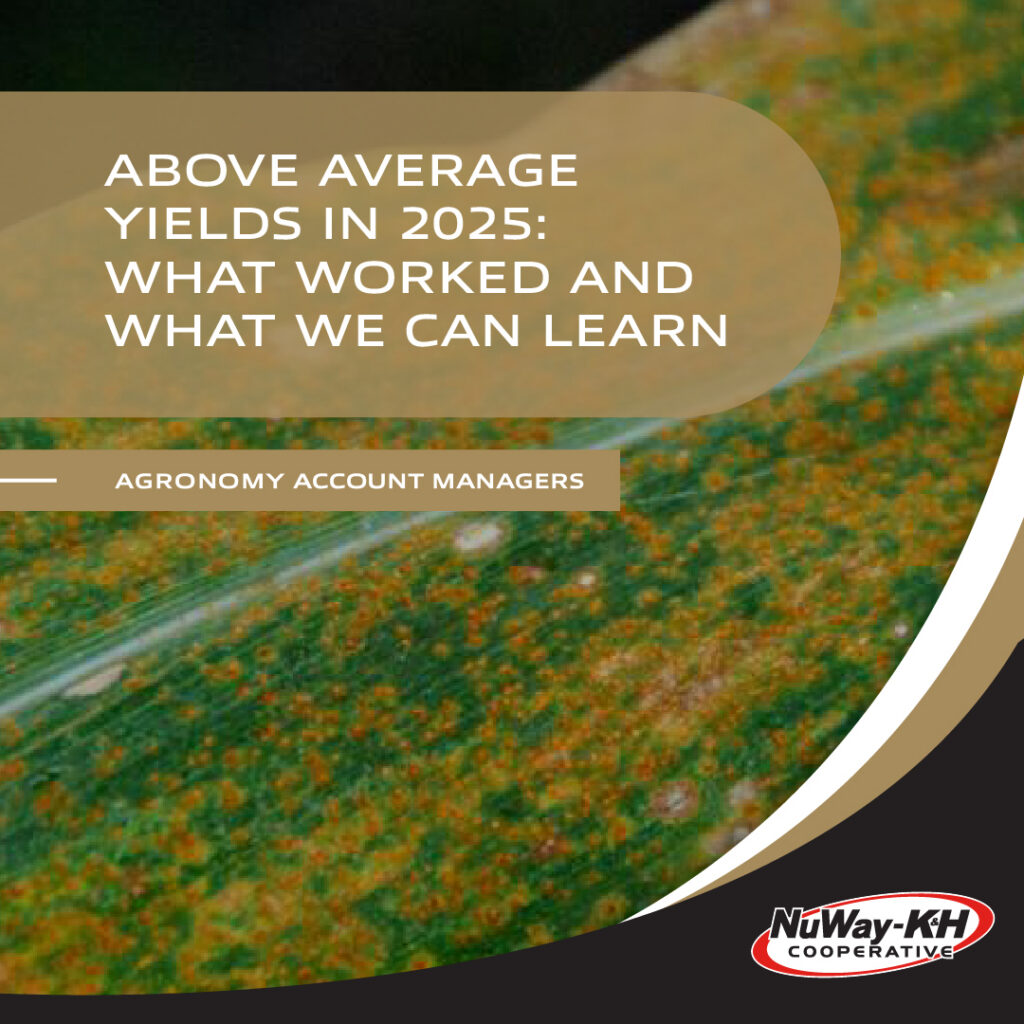
Disease pressure, especially from tar spot and southern rust, was elevated in 2025 due to high humidity, frequent morning dews, and foggy conditions. Growers who applied fungicide at the right time saw big results, with NuWayK&H trials showing a 16 bu/ac response in corn (91% win rate) and 3.9 bu/ac in soybeans (85% win rate).
Weed Control That Held Strong
While early post-emerge weed control was a challenge due to cooler temps, growers who adapted their strategy, including Zidua-based residuals in soybeans, saw better long-term weed suppression and fewer late-season escapes.
Adapting In-Season Based on Environment
By tassel time, many growers could clearly see the yield potential shaping up and adapted accordingly. Whether that meant adding a fungicide pass or dialing in lateseason fertility, the ability to make those timely decisions was a difference-maker.
A Note on Perspective
While 2025 brought the right mix of conditions, we know every season is different. The key takeaway is this, by managing proactively and adjusting based on what your field and the environment tell you, you set yourself up for success no matter what the season brings
TIMELINE OF KEY YIELD DRIVERS
TIMEFRAME |
KEY YIELD DRIVERS |
| Winter & Early Spring | Hybrid/variety selection, placement decisions, nitrogen planning |
| Planting Window | Timely planting, strong emergence, early weed control |
| May–June | Root development, nutrient uptake, weather-dependent nitrogen mineralization |
| Early Summer (V6–Tassel) | Evaluate crop condition, assess disease risk, apply fungicide where needed |
| Mid–Late Summer | Monitor fields, adjust management, adapt based on environment and yield potential |
| Post-Harvest | Review variety performance, assess ROI on management practices |