

The Big Picture
Energy prices have softened to start the week even as tensions in the Middle East remain high. Attacks on shipping near the Strait of Hormuz and drone strikes in the region are keeping markets on edge, but expectations of ample supply and weaker demand are holding prices in check. Brent crude is trading near $94 a barrel.
What Is Moving the Market
Geopolitics and Shipping
Iran launched drones at US air defense sites in Bahrain, and the Houthis targeted a Saudi pipeline; no flow disruptions were reported.
Several tankers, including an LPG tanker, were struck or caught fire near the Strait of Hormuz, raising risks for commercial shipping.
Iraq has revived an overland trucking route to a Mediterranean port to diversify crude exports, though higher costs and limited trucks restrict how far it can grow.
Ukraine launched its largest drone attack of the war, and Russian refineries continue to be hit, lowering Russian refinery throughput even as crude exports reach their highest level since July.
Supply and Demand
China’s October refinery throughput fell 2% from September and 8.1% from a year earlier, signaling softer demand.
China’s diesel exports rose 89.2% year over year in October, while gasoline exports fell 27.8%.
Chinese independent refiners are buying more Middle Eastern crude as premiums fall.
OPEC is reviewing member production capacity ahead of an OPEC+ meeting on November 29, where ministers will decide 2027 output policy.
Asian nations are discussing coordinated oil stockpiling to protect against future supply disruptions.
US Inventories
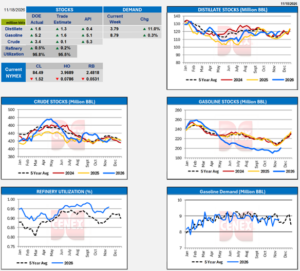
A Reuters poll expected a small 60,000-barrel crude build, with gasoline stocks up 1.65 million barrels and distillates up 1.25 million barrels. Refinery utilization was projected at 95.4%.
API data showed larger builds in crude (5.28 million barrels) and gasoline (5.12 million barrels), and a smaller distillate build (351,000 barrels). The official EIA report is due Wednesday.
Financial Markets
Speculative buying has dropped: WTI net length is at a 9-month low, ULSD at a 10-month low, and RBOB at a 2-month low.
The Fed is widely expected to raise interest rates next month, and the US dollar is at a 19-month high, which adds pressure on commodity prices.
What It Means for Gasoline and Diesel
Diesel: ULSD futures are testing key support around $4 per gallon and the 200-day moving average, a level that has not been successfully challenged since January. A break lower could bring further relief, but diesel remains sensitive to refinery disruptions and shipping news.
Gasoline: RBOB and WTI have broken below last week’s lows, trading at their lowest levels since March and August, respectively. Larger-than-expected gasoline inventory builds point to ample supply.
Market Outlook
The near-term outlook is mixed. Prices could stay volatile because geopolitical risk remains elevated, and further attacks on shipping or oil infrastructure could quickly push prices higher. Over the medium term, the balance of risks points lower.
Forecasts: Goldman Sachs expects Brent to average $88 a barrel next year and ease to $78 by December 2027, with WTI averaging $78 and slipping to $70 by the end of 2027. It projects a global oil surplus of about 2 million barrels per day in 2027.
Near-term risks: Goldman also sees upside risk to prices from intensified shipping attacks and damage to oil infrastructure.
Downward pressure: Rising inventories, weaker demand, reduced speculative positioning, a stronger dollar and possible interest rate hikes all point to softer prices.
Events to watch: the EIA inventory report, peace talks with Iran, President Trump’s meetings in Asia, and the November 29 OPEC+ meeting.
If you have any questions or would like current pricing, please contact your Energy Account Manager.
Propane
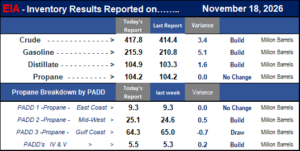
- Propane/propylene inventories were unchanged for the week at 104.2 million barrels (MB).
- Year over year, propane inventory is 1.1% lower than at this time last year.
- Total commercial petroleum inventories rose by 9.2 million barrels for the week.
Regional Inventory Changes
Gains in some regions offset a draw in the Gulf Coast, leaving the national total flat.
- Region – Weekly Change
- Gulf Coast (PADD 3) Down 700,000 bbl
- Midwest (PADD 2) Up 500,000 bbl
- East Coast (PADD 1) Unchanged
- Rocky Mountain & West Coast (PADD 4 & 5) Up 200,000 bbl
Market Outlook
Based on this week’s data, we expect a steady-to-supportive propane market in the near term:
- Supply is stable. With national inventories flat at 104.2 MB, there is no sign of a sudden supply surge or shortage.
- Slightly tighter than last year. Inventories running 1.1% below last year may offer some price support, especially if cold weather increases demand.
- Regional balance is shifting. The Gulf Coast draw alongside Midwest builds suggests product is moving toward the Midwest, which is helpful for local supply availability.
- Broader energy markets are well supplied. The 9.2 million barrel increase in total commercial petroleum inventories could limit upward pressure on overall energy prices.
If you have any questions or would like current pricing, please contact your Energy Account Manager.
NuWay-K&H Cooperative Customer Portal
Through our portal, you can check billing, make payments, request a quote, check previous years product usage, see invoices and statements, and much more. We also offer digital contracting through the portal where you can sign and pay your energy contracts through our mobile app or desktop site. Click here log in!(opens in new tab)