

Energy markets remain focused on a mix of Middle East supply risk, OPEC+ production decisions, global demand, and refined fuel availability. Crude oil has been choppy, with geopolitical headlines adding support while improving supply flows and uneven demand has kept prices from breaking sharply higher. For customers buying gasoline and diesel, the biggest takeaway is that refined products continue to carry more market sensitivity than crude itself, especially as summer travel demand remains strong and diesel supply risks remain tied to global refinery disruptions.
Key Market Drivers
Middle East tensions remain a major risk factor. Recent reports of tanker damage near the Strait of Hormuz and continued uncertainty around the U.S.-Iran ceasefire have kept geopolitical risk in the market. The Strait of Hormuz is a critical route for global crude and fuel movement, so any disruption to shipping can quickly support crude, gasoline, and diesel prices.
OPEC+ is adding barrels, but actual supply remains uneven. OPEC+ approved another production increase for August, and the UAE has also raised output sharply. In normal conditions, that would be a bearish signal for crude prices. However, actual production from several producers remains below target, and regional disruptions have limited how much supply is truly reaching the market.
Diesel remains sensitive to global refinery issues. Ongoing attacks and disruptions involving Russian energy infrastructure continue to create concern around diesel availability. While there has not been a confirmed nationwide Russian diesel export ban, refinery interruptions increase the risk of tighter global diesel supply, which can support diesel prices even when crude is under pressure.
Gasoline demand is being supported by summer travel. Holiday travel demand has been strong, with record Independence Day travel estimates helping stabilize the gasoline market after a period of lower retail prices. This demand support has helped refined products outperform crude at times.
U.S. crude inventories are tight. The Strategic Petroleum Reserve has fallen near a 40-year low, and combined U.S. commercial and government crude inventories have dropped significantly. Reserve releases have helped cushion the market, but rebuilding those barrels later could add future demand for crude.
Market Outlook
The near-term outlook remains mixed. On one hand, added OPEC+ production, stronger UAE output, recovering Gulf export flows, and potential Chinese fuel exports could help keep the market adequately supplied. On the other hand, instability around Iran, sanctions on Iranian oil, tanker security concerns near the Strait of Hormuz, low U.S. reserve levels, and Russian refinery disruptions all keep risk premium in the market. For customers, that means gasoline and diesel prices may remain rangebound but vulnerable to sudden higher moves if shipping disruptions worsen or refinery issues tighten product supply. Diesel has the greater upside risk if global refinery outages continue, while gasoline may stay supported by travel demand but could see some relief if exports from China increase. In this environment, customers may want to stay closely engaged on pricing opportunities rather than waiting for a clear market direction.
If you have any questions or would like current pricing, please contact your Energy Account Manager.
Propane
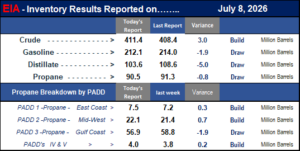
Propane inventories took an unexpected step lower this week, mainly because of a sharp increase in exports. Instead of the expected inventory build of about 2.2 million barrels, the EIA reported a draw of roughly 845,000 barrels, bringing total U.S. propane stocks to about 90.5 million barrels.
The biggest factor behind the draw was exports, which jumped to approximately 2.6 million barrels per day, up about 709,000 barrels per day from the previous week. Production was slightly higher, imports also increased modestly, and domestic demand moved lower, but the strong export pace more than offset those supply gains.
Even with this week’s draw, propane inventories remain in a comfortable position compared to last year. Stocks are about 12.1 million barrels higher than a year ago, which puts inventories roughly 15.4% above year-ago levels.
There is also attention on Energy Transfer’s Nederland export facility, which has been down since June 25 due to a compressor issue. The facility is expected to come back online this week. Nederland has significant propane export capacity, so its return could help keep export volumes strong if global demand remains active.
Market Outlook
The propane market still appears well supplied overall, but this week’s unexpected draw is a reminder that exports can quickly change the weekly inventory picture. If export demand stays strong, especially with Nederland returning to service, inventory builds may be smaller than expected in the near term.
For propane customers, the current inventory cushion is a positive factor, but export activity will be important to watch. A continued strong export pace could add support to prices, while larger inventory builds later in the season would help ease market pressure.
If you have any questions or would like current pricing, please contact your Energy Account Manager.
NuWay-K&H Cooperative Customer Portal
Through our portal, you can check billing, make payments, request a quote, check previous years’ product usage, see invoices and statements, and much more. We also offer digital contracting through the portal, where you can sign and pay your energy contracts through our mobile app or desktop site. Click the button below to log in!